LMU Alumna Anna-Maria Walter: life, love, and marriage in the mountains
31 Aug 2026
Anthropologist Anna-Maria Walter researches relationships and digital communication, mountain tourism, and different forms of knowledge about snow, ice, and glaciers.
While cleaning her teeth in the inner courtyard early in the morning, Anna-Maria Walter had an almost unreal view: “From the water spring, I saw countless six- and seven-thousanders all around me, covered by snow and glaciers, sometimes shrouded by clouds.” For her research, the anthropologist lived in oasis villages in northern Pakistan for over a year. “Because of the meltwater, they’re surprisingly lush and green, surrounded by barren alpine desert.”
The anthropologist and LMU alumna researches how people live in mountain regions, how they perceive their environment, and how they deal with social and environmental changes. “I’m interested in how people structure their relationships to each other and their environment, and in how these relationships change over time.”
Walter studied social and cultural anthropology at LMU and completed various internships, including at the Five Continents Museum in Munich and the UN Food and Agriculture Organization in Rome. She wrote her Magister thesis in 2009 about the social effects of the cellphone in rural India. “At that time, there was often just one cellphone per village – it was like a telephone booth for everybody.” After a research stint in southern India, she did her doctorate under Professor Martin Sökefeld at LMU’s Institute of Social and Cultural Anthropology. Her topic was “Intimate connections – Conjugal affection amid Gilgit’s high mountains, Islamic doctrines and mobile phones.”
I’m interested in how people structure their relationships to each other and their environment, and in how these relationships change over time.
Dr. Anna-Maria Walter
Crystal palaces and mobile communication
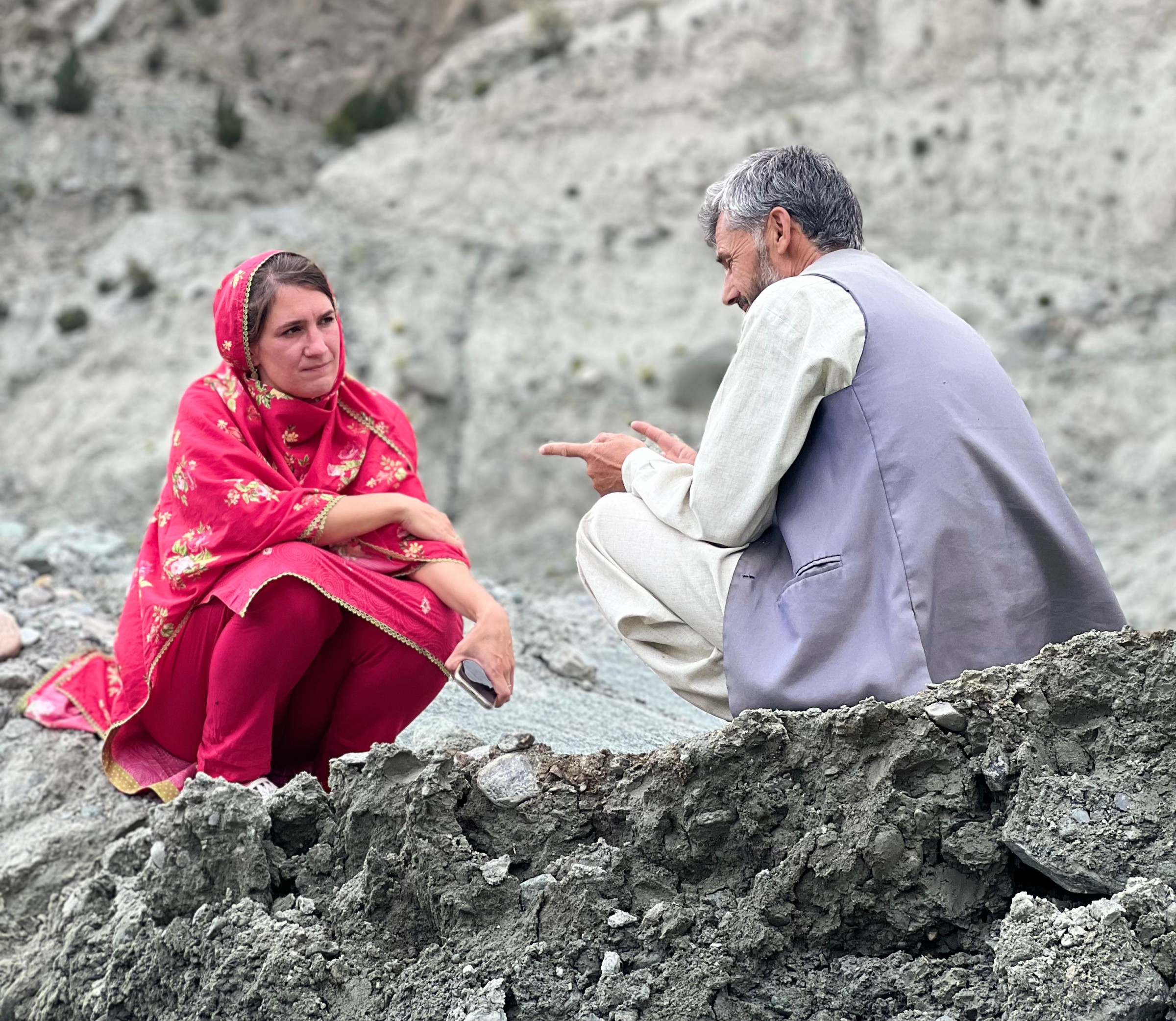
In 2011, she traveled to Pakistan for the first time – and kept returning to the country from then on. “I learned Urdu and was fascinated by the country’s riches, from the Mughal architecture to shrines at which people sing, dance, and make music.” For her field research, she spent a total of 15 months in the high mountain ranges of northern Pakistan, in a valley near the city of Gilgit. She lived with various families there – to experience their everyday life and their cellphone usage habits. “Initially, young people communicated mostly by SMS,” she notes, “and then later by WhatsApp.”
I learned Urdu and was fascinated by the country’s riches, from the Mughal architecture to shrines at which people sing, dance, and make music.
Dr. Anna-Maria Walter
Walter spent most of her time with the women of the respective family. As well as conducting interviews, she did ethnographic research by taking part in everyday life. “The goal is to build up solid, lasting relationships and create trust.” So she helped out with cooking, in the garden, or looking after children. “Among the younger women, marriage was a constant topic of conversation: Some of them were engaged, while marriages had been arranged for others as per the custom in that part of the world.” On the one hand, the young women sought the advice of female shamans in matters of the heart. According to local mythology, these shamans obtained their insights from fairies that live in crystal palaces on the snow-covered peaks. On the other hand, rapidly developing mobile communication also played a major role.
In the Shia-Muslim environment Walter studied, social and religious norms also governed the contact between unmarried women and men. For example, they were not supposed to send each other messages. In addition, the young women’s ability to make phone calls was limited through control over their finances. “To pay for credit and data, young women often had to ask their husband, big brother, or father for money.” Yet in everyday life, the boundaries were far less clear-cut than the approximately 100 interviews Walter conducted initially indicated. “For instance, one mother, who was illiterate, got her daughter to help her read and write messages on the cellphone, and in return she turned a blind eye to the daughter’s private messages.”
Closeness by SMS
According to Walters’ research, while cellphones did not dissolve the traditional rules around love and marriage, they created new latitude. “In particular, the phase between the arrangement of a marriage and the actual moment when a woman moved into the house of a man changed,” observes Walter. “The future spouses were able to develop emotional proximity via text messages and form a certain bond.” Older interviewees who had married in the eighties or nineties, by contrast, hardly knew their husband when they moved into the house of his family – and the other women in the home were their main points of reference initially.
For two hours every morning, I would set down my thoughts and observations from the previous day on my computer.
Dr. Anna-Maria Walter
The proximity to family members required for her ethnographic research also had its challenges for Walter. “In the everyday hustle and bustle, naturally it wasn’t easy to carve out space for myself.” She found a daily refuge in her field notes. “For two hours every morning, I would set down my thoughts and observations from the previous day on my computer,” recalls the anthropologist. “That was also a way of switching off.”
After various residencies, including at the University of Exeter in England, the anthropologist worked as a postdoctoral researcher at the University of Oulu in Finland. “While there, I conducted research into the social and ecological aspects of ski touring in the Alps and into the question of how the perception of mountain landscapes has changed over time.” In further studies, Walter has pursued her interest in mountain landscapes, snow, and glaciers – the so-called cryosphere – and in the question of how people perceive and change them.
Knowledge of fairies and glaciers
In 2024, she took up a postdoctoral role at the Rachel Carson Center for Environment and Society at LMU, were she researched how people perceive and understand snow, ice, and glaciers in the Alps and the Himalayas. In the 2025 summer semester, moreover, she spent six months as Junior Researcher in Residence at LMU’s Center for Advanced Studies (CAS). “This half a year at the CAS really brought on my research a lot,” says Walter. “Without teaching obligations, I had time to organize all the things I had read, experienced, and researched to date and get it down on paper in systematic fashion. Equally, I was able to explore what directions could be fruitful for my future research.”
Interview with the teacher of a boys' school in the Bagrot Valley, who spoke about the long-standing tradition of glacier grafting.
She also organized a workshop during this period. “This gave me the opportunity for the first time to bring together researchers from the Himalayas and the Alps, including local glacier experts,” explains Walter. Among them were cooperation partners from Switzerland, but also from the University of Baltistan in Pakistan.
For the non-profit association Asian Mountain Academic Alliance (AMAA), she took part in the World Day for Glaciers in Paris – “to open channels for collaboration on an equal basis and combine different types of knowledge – glaciological and cosmological knowledge, such as stories about fairies that watch over glaciers.”
Above all, I want to flip the usual script, where researchers from the Global North travel to the Global South – and to collaboratively shape research in the Alps and the Himalayas on an equal footing.
Dr. Anna-Maria Walter
From the country to the city and back again
Since last fall, she has been part of the Sustainable Urban Environments research group at the Technical University of Munich. “We’re trying to understand cities from the outside in – because urban and rural life are so interconnected,” says Walter. “For example, people work in the city but then spend the holidays on their parents’ farm.” The same goes for food and energy production: “Many things that happen in the country reach the city and then come back again.”
In her next research project, she would like to investigate how people combine different forms of knowledge about things like glaciers, water, or the environment. “When do we draw on which knowledge? How do we deal with contradictions? And how do we explain the differences between the various knowledge sources that we simultaneously carry within us?”
Anna-Maria Walter is currently working on research proposals. Part of her goal here is to help early-career researchers from South Asia obtain a residency in Europe. In this way she wants to promote greater scientific exchange in both directions. “Above all, I want to flip the usual script, where researchers from the Global North travel to the Global South – and to collaboratively shape research in the Alps and the Himalayas on an equal footing.”